Donald Trump's lawyers have filed a motion in the pending class action case over Trump University to exclude from evidence any statements made during the presidential campaign, including his own. The case is scheduled to go to trial in November and Trump's lawyers argue that all the negative statements about Trump made by political rivals, and apparently all of his own statements in defense, are irrelevant and prejudicial. Most legal commentators agree that the judge is unlikely to enter such a sweeping order and will likely wait to rule on individual offers of proof during trial.
Certainly, juries should not have to wade through irrelevant material and undue prejudice must be avoided in every trial. But isn't a party's motion to exclude his own prior statements a bit of a red flag?
Ironically, Trump previously tried to keep evidence from the Trump U case from being released into the presidential campaign. It was the judge's order allowing the release that caused Trump to attack the judge's impartiality because of his Mexican Heritage - a ploy that harmed his political fates.
Showing posts with label judges. Show all posts
Showing posts with label judges. Show all posts
Tuesday, October 25, 2016


Tuesday, October 18, 2016
One Case, Three Law Lessons
Sexual assaults on college campuses are a matter of great concern. Changes in the way that colleges and universities handle campus disciplinary proceedings based on allegations of sexual assault have changed radically in the last few years. Those teaching law in universities are likely well aware of the panoply of legal issues raised by lowering the evidentiary standards for proof of guilt, barring cross examination or witness confrontation and other issues. (Click here to read an article on the topic by ALSB member, Audrey Wolfson LaTourette.)
Brown student, John Doe, had been found "responsible" for sexual misconduct by a University tribunal and was suspended. The case hinged on a factual dispute regarding consent. At the time of the incident, the University had no clearly defined definition of consent, although one was later adopted. Doe was suspended based on the retroactive application of the definition. Also, he was barred from presenting evidence in his defense.
Doe challenged the faulty procedure in federal court. Because Brown is a private university, Doe did not have a due process claim. He filed suit for breach of contract. Recently, Chief Judge William E. Smith of the U.S. District Court for the District of Rhode Island, ruled in Doe's favor and ordered his reinstatement at Brown.
Lesson 1: Disputes must be resolved by a fair procedure of which both parties have had prior notice.
Sexual assaults on college campuses trigger deep emotions. Victims deserve sympathy, support, validation and ultimately, justice. But the accused must also not be denied the legitimate opportunity to defend against the claims. The criminal justice system, with its Constitutional protections for the accused has been developed and fine tuned over the last two centuries. Finding and developing a completely different private adjudicatory system in colleges and universities that gives adequate consideration to the legitimate interests of victims and accused alike is a minefield of litigation.
Lesson 2: Federal judges cannot be lobbied like legislators. They are appointed for life specifically to be less influenced by public opinion and passions. The same principles may or may not apply to elected state court judges.
Brown student, John Doe, had been found "responsible" for sexual misconduct by a University tribunal and was suspended. The case hinged on a factual dispute regarding consent. At the time of the incident, the University had no clearly defined definition of consent, although one was later adopted. Doe was suspended based on the retroactive application of the definition. Also, he was barred from presenting evidence in his defense.
Doe challenged the faulty procedure in federal court. Because Brown is a private university, Doe did not have a due process claim. He filed suit for breach of contract. Recently, Chief Judge William E. Smith of the U.S. District Court for the District of Rhode Island, ruled in Doe's favor and ordered his reinstatement at Brown.
Lesson 1: Disputes must be resolved by a fair procedure of which both parties have had prior notice.
Sexual assaults on college campuses trigger deep emotions. Victims deserve sympathy, support, validation and ultimately, justice. But the accused must also not be denied the legitimate opportunity to defend against the claims. The criminal justice system, with its Constitutional protections for the accused has been developed and fine tuned over the last two centuries. Finding and developing a completely different private adjudicatory system in colleges and universities that gives adequate consideration to the legitimate interests of victims and accused alike is a minefield of litigation.
Lesson 2: Federal judges cannot be lobbied like legislators. They are appointed for life specifically to be less influenced by public opinion and passions. The same principles may or may not apply to elected state court judges.
Judge Smith had been the target of a substantial e-mail lobbying campaign intended to affect his ruling. In blasting the effort, Judge Smith explained:
[T]he court is an independent body and must make a decision based solely on the evidence before it. It cannot be swayed by emotion or public opinion. After the preliminary injunction, this Court was deluged with emails resulting from an organized campaign to influence the outcome. These tactics, while perhaps appropriate and effective in influencing legislators or officials in the executive branch, have no place in the judicial process. This is basic civics, and one would think students and others affiliated with a prestigious Ivy League institution would know this. Moreover, having read a few of the emails, it is abundantly clear that the writers, while passionate, were woefully ignorant about the issues before the Court.
Before the court was only the issue of the procedural propriety of the tribunal - not the issue of guilt or innocence.
Lesson 3: The law is not just a set of predetermined rules that are mechanically applied to achieve justice. There is a lot of trial and error and experimentation and evolution. And in that process, real people's lives are affected.
Cases are not just academic thought exercises. They are the legal outcomes of real, often tragic, events affecting real people. Courts do not have the advantage of legislators who can pass a law and send it out into society to see what happens. Judicial rulings apply immediately to affect the lives of the litigants in often profound ways.
[T]he court is an independent body and must make a decision based solely on the evidence before it. It cannot be swayed by emotion or public opinion. After the preliminary injunction, this Court was deluged with emails resulting from an organized campaign to influence the outcome. These tactics, while perhaps appropriate and effective in influencing legislators or officials in the executive branch, have no place in the judicial process. This is basic civics, and one would think students and others affiliated with a prestigious Ivy League institution would know this. Moreover, having read a few of the emails, it is abundantly clear that the writers, while passionate, were woefully ignorant about the issues before the Court.
Lesson 3: The law is not just a set of predetermined rules that are mechanically applied to achieve justice. There is a lot of trial and error and experimentation and evolution. And in that process, real people's lives are affected.
Cases are not just academic thought exercises. They are the legal outcomes of real, often tragic, events affecting real people. Courts do not have the advantage of legislators who can pass a law and send it out into society to see what happens. Judicial rulings apply immediately to affect the lives of the litigants in often profound ways.
Thursday, October 6, 2016
Crash Course: Judicial Decisions
Another video from the PBS Crash Course Series on Government. I am assigning some of these as in, "They will be on the test."
Friday, September 23, 2016
Law Music Video: My Judge and My Jury
Classic Doo Wop with a classic legal theme. Play it before class as your students are getting settled. Music stimulates brain neurons preparing your students to think.
Tuesday, September 20, 2016
Judicial Selection by Election and the Rule of Law
A recent federal lawsuit challenges the Alabama electoral process for selection of state judges. The allegation is that statewide judicial selection assures the failure of minority candidates for the bench. Think Progress reports:
Judges and Faith and Values:
Judges and Church Participation:
Judges and Life Experience:
The lawsuit notes that
since 1994, every African American candidate that has run for any of the three
top courts has lost to a white candidate. Only two black judges have ever been
elected to the state Supreme Court, and zero have served on either the Court of
Criminal Appeals or the Court of Civil Appeals in the entirety of the state’s
history.
State Judicial elections were employed from the very founding of the nation as a way to ensure judicial accountability and counter elitism and political cronyism in judicial selection. But judges are supposed to be accountable to the rule of law, not to popular sentiment. The string of videos of campaign ads below raise significant questions about judicial fidelity to the rule of law. They seem to use code phrases and images to portray a fidelity to political ideology or religious principles or popular "values." Some promise "proper" interpretation of the Constitution - whatever that means.
What does it take to get elected to a judicial position? Is the belief that judges adhere to a "rule of law" just a quaint relic of judicial philosophy? Or is law inherently constituted of a judge's background, beliefs, upbringing, prejudices, "values," religion, education, political ideology and world view? Do we know this, implicitly, and cling publicly to the "rule of law" to maintain legitimacy? What do we deduce from these ads?
"Proper" Constitutional Interpretation:
Judges and Faith and Values:
Judges and Church Participation:
Judges and Life Experience:
Friday, November 7, 2014
Tuesday, September 24, 2013
No Laughing Matter
The LSCB previously commented on the trials of comic Vince August, a/k/a South Hackensack, New Jersey municipal judge, Vince Sicari. Previously ordered by the State Ethics Board to give up one of the jobs, Vince appealed to the state Supreme Court. The court ruled unanimously against him.
Yahoo news reports:
"In the course of his routines, Sicari has demeaned certain people based on national origin and religion and has revealed his political leanings," according to the court's opinion. "The court cannot ignore the distinct possibility that a person who has heard a routine founded on humor disparaging certain ethnic groups and religions will not be able to readily accept that the judge before whom he or she appears can maintain the objectivity and impartiality that must govern all municipal court proceedings."
...and that is no laughing matter.
According to the New York Times, Sicari has resigned the judgeship, leaving behind his $13,000 annual income.
"Now appearing, Vince August."
"Thank you, ladies and gentlemen. I'll be here all week."

source of image: http://cliffviewpilot.com/south-hackensack-judge-takes-the-standup-with-the-supremes/
Oyay! Oyay! Oyay! Now presiding, the Honorable Judge Vincent Sicari:

source of image: http://comedybeat.com/jan2020_articles/njlj_judge_sicari_barred_from_stage_10-18-2010.html
Yahoo news reports:
"In the course of his routines, Sicari has demeaned certain people based on national origin and religion and has revealed his political leanings," according to the court's opinion. "The court cannot ignore the distinct possibility that a person who has heard a routine founded on humor disparaging certain ethnic groups and religions will not be able to readily accept that the judge before whom he or she appears can maintain the objectivity and impartiality that must govern all municipal court proceedings."
...and that is no laughing matter.
According to the New York Times, Sicari has resigned the judgeship, leaving behind his $13,000 annual income.
"Now appearing, Vince August."
"Thank you, ladies and gentlemen. I'll be here all week."
source of image: http://cliffviewpilot.com/south-hackensack-judge-takes-the-standup-with-the-supremes/
Oyay! Oyay! Oyay! Now presiding, the Honorable Judge Vincent Sicari:
source of image: http://comedybeat.com/jan2020_articles/njlj_judge_sicari_barred_from_stage_10-18-2010.html
Monday, March 4, 2013
Is This Another Lawyer Joke?
A judge and a stand-up comedian go to the movies but they only need one ticket. Why is that? Because they are the same person!
In 2008, part time New Jersey municipal court judge, Vince Sicari (a/k/a Vince August), was ordered by the ethics commission to give up his "day" job as a stand-up comic. Sicari has appealed the ruling and the New Jersey Supreme Court heard arguments last week. Read the NY Times article here for details.
In my opinion, having a judge with a sense of humor is a plus.
In 2008, part time New Jersey municipal court judge, Vince Sicari (a/k/a Vince August), was ordered by the ethics commission to give up his "day" job as a stand-up comic. Sicari has appealed the ruling and the New Jersey Supreme Court heard arguments last week. Read the NY Times article here for details.
In my opinion, having a judge with a sense of humor is a plus.
Thursday, February 16, 2012
Tuesday, October 25, 2011
Featured Website: The Georgia Civil Justice Foundation
The Georgia Civil Justice Foundation maintains a website with a wealth of materials to assist in educating students about the law. I have made regular use of their videos and animations, accessed by scrolling over the book titles on the bookshelf exhibited at the webpage. Some of the videos are available at a YouTube channel, if that gives you more flexibility in using these resources.
Tuesday, August 30, 2011
Justice Scalia Says Natural Law is Relative
According to Justice Scalia's comments in the video below, "Natural Law" is whatever the majority says it is. So, if the majority decides that same sex marriage (for example) is not to be allowed, then that is what "nature" dictates. It follows, then, that if the majority votes that public corporations should not have the same free speech rights as natural persons, then that should be law, despite constitutional protection (as interpreted by the Supreme Court). In reading Justice Scalia's comments during oral arguments and his decisions, one would conclude that Justice Scalia fancies himself an historian. How many times in the course of American history has "natural law" been used to justify denial of basic rights to unpopular minorities? In a democracy, is there not a need for an institution that protects against the tyranny of the majority?
Justice Scalia also queries what qualities of judges make them more qualified to determine what the law is than the democratic majority. This video can be a good device to raise the counter-majoritarion difficulty for class.
Justice Scalia also queries what qualities of judges make them more qualified to determine what the law is than the democratic majority. This video can be a good device to raise the counter-majoritarion difficulty for class.
Tuesday, April 19, 2011
Legal Realism: Justice is Best Served on a Full Stomach
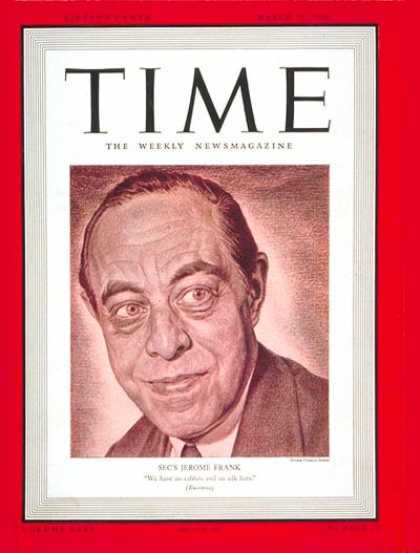
Leading Legal realist Judge Jerome Frank is credited with the phrase that "Justice is what the judge ate for breakfast." I have never tracked down that precise quote from him but perhaps it is drawn from this passage found at p.162 of my well worn copy of Courts on Trial:
Judge Milian must have had the 4-alarm chili! (But she was right)
Out of my own experience as a trial lawyer, I can testify that a trial judge, because of overeating at lunch, may be somnolent in the afternoon court-session that he fails to hear an important item of testimony and so disregards it when deciding the case. “The hungry judges soon the sentence sign, And wretches hang that juryman may dine,” wrote Pope. Dickens’ lovers well remember Perker’s advice to Pickwick: “A good, contented, well-breakfasted juryman, is a capital thing to get hold of. Discontented or hungry jurymen, my dear sir, always find for the plaintiff.”
I have long ago worked this concept into class asking student to consider what might happen to convicts sentenced in the afternoon after the judge had a bowl of 4-alarm chili. Now an empirical study from Israel ties judges' decisions on criminal dispositions to the proximity the case action bears to the judge's break times. It appears that judges are more lenient after meals and breaks and less lenient the longer they sit on the bench following a break. I think Judge Frank would have flashed a wry smile at these results.Judge Milian must have had the 4-alarm chili! (But she was right)
Subscribe to:
Comments (Atom)