Let's watch and discuss:
Showing posts with label negligence. Show all posts
Showing posts with label negligence. Show all posts
Tuesday, January 28, 2014
More Legal Causation Explained
Perhaps the fact that you have cable TV was an actual cause of your father getting punched in the stomach over a can of soup. But was it a PROXIMATE cause - a legal cause? Was it reasonably foreseeable that having cable could result in such an injury? Was your father's injury a "natural and probable result" of your TV service choices?


Wednesday, April 24, 2013
Do Hospitals Profit From Negligence?
According to a study published in the Journal of the American Medical Association, some hospitals make money due to surgical errors resulting in complications. Does this mean that hospitals may have an incentive to delay or refrain from implementing better safety standard controls? I guess one would have to read the report.
According to the report's conclusions:
In this hospital system, the occurrence of postsurgical complications was associated with higher per-encounter hospital contribution margin for patients covered by Medicare and private insurance but lower contribution margin for patients covered by Medicaid and self-payment. Depending on payer mix, some hospitals have the potential for adverse near-term financial consequences for decreasing postsurgical complications.
According to the report's conclusions:
In this hospital system, the occurrence of postsurgical complications was associated with higher per-encounter hospital contribution margin for patients covered by Medicare and private insurance but lower contribution margin for patients covered by Medicaid and self-payment. Depending on payer mix, some hospitals have the potential for adverse near-term financial consequences for decreasing postsurgical complications.
Thursday, March 14, 2013
Standard of Care
What is the "standard of care" - the breach of which must be proven to recover in a medical negligence case?
Friday, February 22, 2013
Law Music Video: Prof. Steven Friedell
Who would ever have thought that singing songs in classes with adults could be an effective pedagogical method? What else can be said about watching an exceptional teacher at work? Here is Prof. Steven Friedell, Rutgers Law.
Tuesday, November 27, 2012
Negligence Claims and Insurance Contract Claims
Which of the mishaps pictured in the Liberty Mutual Ins. Co. ads below may give rise to civil tort claims for negligence? Which give rise to a contractual claim for indemnity from an insurance policy? Which are just funny mishaps?
>
>
Monday, October 8, 2012
The Ring of Fire! What Could Possibly Go Wrong?
Are you kidding me??!! Watch the video in the news report below and then ask your students who has liability?
The Lions Club sponsors a Country Fair in Berlin, Connecticut. One of the hired "acts" is something (a company? a voluntary association?) called Xtreme Team Bullriders (it may or may not be these folks). One of the "shows" is called the Ring of Fire. Contestants pay $20 each to get into a ring marked out in chalk while a live bull is released into the arena. The last one standing in the ring wins $100. What could possibly go wrong? Let's just say it involves use of a Life Star helicopter and an ambulance.
Read the news report and see the video, here.
Note the comments of the Lion's Club public safety representative at the end of the report. Does the Lion's Club have any responsibility? The report notes that the contestants signed waivers. Fortunately for the injured parties, the State of Connecticut courts have ruled that liability waivers that purport to insulate a party for its own negligence violate public policy and are unenforceable.
Here is a video of the same "game" played elsewhere:
Johnny Cash with a saner "Ring of Fire."
The Lions Club sponsors a Country Fair in Berlin, Connecticut. One of the hired "acts" is something (a company? a voluntary association?) called Xtreme Team Bullriders (it may or may not be these folks). One of the "shows" is called the Ring of Fire. Contestants pay $20 each to get into a ring marked out in chalk while a live bull is released into the arena. The last one standing in the ring wins $100. What could possibly go wrong? Let's just say it involves use of a Life Star helicopter and an ambulance.
Read the news report and see the video, here.
Note the comments of the Lion's Club public safety representative at the end of the report. Does the Lion's Club have any responsibility? The report notes that the contestants signed waivers. Fortunately for the injured parties, the State of Connecticut courts have ruled that liability waivers that purport to insulate a party for its own negligence violate public policy and are unenforceable.
Here is a video of the same "game" played elsewhere:
Johnny Cash with a saner "Ring of Fire."
Thursday, August 30, 2012
Men Are Not Reasonably Prudent
There are many video examples of people failing to act up to the standard of ordinary care. This one comes from an insurance company that insures women, only . . . ostensibly with good reason.
Friday, April 20, 2012
Warning! Not Responsible For Damages ... Because I Said So
Have you ever been behind a large construction truck bearing a sign that warns you to stay back because the construction company is "not responsible for damages."
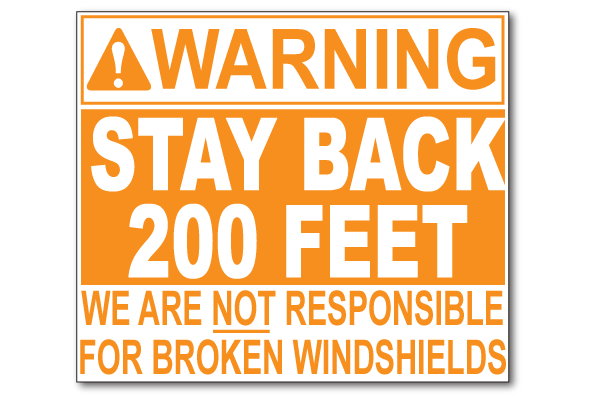
Source of Image: HHH, Inc. : http://www.hhhincorporated.com/stay-back-200-feet-sticker.html
Is this the legal doctrine of "Self-Proclaimed Immunity?" Ostensibly, it is an attempt to publicize the existence of an inherent danger that may not be obvious to the following vehicle. And it is probably to cumbersome for the sign to read "You have been warned that construction vehicle may spew stone and rock at any time regardless of the level of care or precaution that has been exercised by the construction crew and the driver of the vehicle. So, protect yourself by staying back more than half the length of a football field or take another route home." But I think that is what is meant. Thanks for the warning, but if you are negligent, you can't escape liability on the basis of "I told you so!"
Where is the outrage!
Source of Image: HHH, Inc. : http://www.hhhincorporated.com/stay-back-200-feet-sticker.html
Is this the legal doctrine of "Self-Proclaimed Immunity?" Ostensibly, it is an attempt to publicize the existence of an inherent danger that may not be obvious to the following vehicle. And it is probably to cumbersome for the sign to read "You have been warned that construction vehicle may spew stone and rock at any time regardless of the level of care or precaution that has been exercised by the construction crew and the driver of the vehicle. So, protect yourself by staying back more than half the length of a football field or take another route home." But I think that is what is meant. Thanks for the warning, but if you are negligent, you can't escape liability on the basis of "I told you so!"
Where is the outrage!
Thursday, April 19, 2012
"No Texting While Walking" Law
For good reason, more and more states are adopting "no texting while driving" laws. But, "no texting while walking" laws, like this one adopted in Rexburg, Idaho, are still pretty rare. But if this story and the videos below are indicative of a growing trend, then there appears to be ample need for more of these laws.
Rexburg, ID:
GRAPHIC!!!! Anti-distracted pedestrian ad:
Rexburg, ID:
GRAPHIC!!!! Anti-distracted pedestrian ad:
Tuesday, March 6, 2012
The Final Element of a Negligence Claim: Damage or Injury
It is axiomatic that if there is no injury or damage, no cause of action for negligence has been proven. Unlike an intentional tort claim, where nominal damages may be awarded symbolically condemning the wrongdoing, a negligence claim lies only where actual harm has been suffered.
Friday, January 27, 2012
Shot Girls: Employees or Independent Contractors?
You are in a bar, enjoying an evening with some friends. One friend has clearly had too much enjoyment and is loudly calling attention to himself and his condition. He is approached by a young woman, barely 18years old, who you have seen many times during the evening carrying a tray of brightly colored shots through the bar, selling them to customers. She approaches your friend and in a matter of a few minutes, she manages to sell him 3 shots at $6 each, which he downs in succession. He slips the "shot girl" a generous tip as she moves on to approach another group of revelers. Later that night, your friend drives his car into an intersection against a red light and paralyzes the driver of another car. Certainly, there must be dram shot liability under these circumstances! But wait - the bar owner says that the "shot girl" was not his employee. Rather, she is an independent contractor - an entrepreneur - earning tips for her services. Is this a scam to avoid liability or is it a legitimate "yellow cab" arrangement? As with most situations in law, it depends . . . on the details of the relationship.
Some of these arrangements sound a but sketchy from a liability standpoint. Others seem to be better organized from a legal standpoint to take advantage of the independent contractor liability rules. Do the shot girls have to carry dram shop insurance?
The Legal Environment of Business is indeed a landscape of craggy hills, leaving a cache of caves and crannies for the clever to covet.
Some of these arrangements sound a but sketchy from a liability standpoint. Others seem to be better organized from a legal standpoint to take advantage of the independent contractor liability rules. Do the shot girls have to carry dram shop insurance?
The Legal Environment of Business is indeed a landscape of craggy hills, leaving a cache of caves and crannies for the clever to covet.
Tuesday, January 24, 2012
Guest Blogger - Henry Lowenstein: Proximate Cause or Cable Remote?
Henry Lowenstein from Coastal Carolina University shares the following video resource:
A colleague of mine (Professor Mark Mitchell, Marketing) passed on some of the new TV ads being run by DirectTV to encourage consumers to switch from cable TV to their direct service. They are hilarious. The one below had me thinking on the issue of "proximate cause" when we teach about torts in our legal environment classrooms. Who really is responsible for injury? Who really should pay? What are the limits of the logic? Is the cell phone company responsible for the distracted driving that leads to an accident or is it the maker of the device itself, or the road, or the car company who didn't warn not to look at the GPS screen while driving? The road to netting potential tortfeasors could be endless and only the courts, juries and legislators put some limitations on it. Common sense and personal responsibility often get lost in the legal "static."
A colleague of mine (Professor Mark Mitchell, Marketing) passed on some of the new TV ads being run by DirectTV to encourage consumers to switch from cable TV to their direct service. They are hilarious. The one below had me thinking on the issue of "proximate cause" when we teach about torts in our legal environment classrooms. Who really is responsible for injury? Who really should pay? What are the limits of the logic? Is the cell phone company responsible for the distracted driving that leads to an accident or is it the maker of the device itself, or the road, or the car company who didn't warn not to look at the GPS screen while driving? The road to netting potential tortfeasors could be endless and only the courts, juries and legislators put some limitations on it. Common sense and personal responsibility often get lost in the legal "static."
The big complaint about the U.S. legal system and raised in debates on tort reform is the expansion of tort theories, by plaintiff attorneys seeking new ways of making cases and cashing-in for "victims" and themselves. So the DirectTV might be a funny way to approach the topic. Is the cable tv company the proximate cause of this individual's "assault." Does he have a cause of action against his cable company for various forms of tort liability and compensation?
Editor's Comment: Maybe this guy could sue Direct TV for not speedily convincing him to switch from cable?
Thursday, December 8, 2011
Law Lessong - Another Day (A Good Samaritan Law Song)
The next installment in the “Law Lessong” series is Another Day. The lyrics for this song were written by Faiven Feshazion, a student in my Legal and Ethical Environment of Business class at the University of Connecticut. Students may submit law songs for credit. In order to fashion a rhyming scheme that matches a melody, a student must carefully examine and distill legal principles and the language that expresses the legal principles. This song helps students consider the absence of a Common Law duty to assist someone who is in danger and, therefore, the public policy behind Good Samaritan statutes.
Learn more about Law Lessongs from the post found here. More videos may be found at my youtube channel. Please feel free to use them in the classroom or as assignments or in any way that they work for you as an educational resource.
Learn more about Law Lessongs from the post found here. More videos may be found at my youtube channel. Please feel free to use them in the classroom or as assignments or in any way that they work for you as an educational resource.
Friday, November 11, 2011
Contingent Fee: 25%
Here is a law firm advertising a reduced contingent fee. What a minute - on uncontested claims? First of all, is there such a thing? And when one comes along, what's the lawyer's job - to deposit the check? Students may be interested in discussing the ethics of this kind of advertising.
Tuesday, November 1, 2011
Guest Blogger- Paula O'Callaghan: Colbert Showcases "Hot Coffee"
Paula O'Callaghan from University of Maryland University College submits the following resource for use in class.
That's a good one, isn't it? Incidentally, this was sent to me by a student after I had covered the Liebeck case in class. Hope you find it useful.
Editor's note. The documentary, "Hot Coffee" is available on DVD beginning today, Nov. 1, 2011.
To access the video clip, click on the image below:

Here's a possible classroom resource - it's Susan Saladoff from the Colbert Report on the Liebeck case and tort reform.
Saladoff is very good as you'd expect, but my favorite part is Colbert's point that if we believe in "jury of our peers" then why isn't McDonald's, being a corporate person, entitled to a jury composed of Burger King, Jack--in-the-Box, and it's corporate peers?!
Editor's note. The documentary, "Hot Coffee" is available on DVD beginning today, Nov. 1, 2011.
To access the video clip, click on the image below:
Thursday, October 27, 2011
Law Lessong - You Owed a Duty to Me
The next installment in the “Law Lessong” series is You Owed a Duty to Me. The lyrics for this song were written by Asley Dorman, a student in my Legal and Ethical Environment of Business class at the Univeristy of Connecticut. Students may submit law songs for credit. In order to fashion a rhyming scheme that matches a melody, a student must carefully examine and distill legal principles and the language that expresses the legal principles. This simple video and song from a Power Point presentation helps students consider the element of "duty" in a negligence claim as a basis for civil liability.
Learn more about Law Lessongs from the post found here. More videos may be found at my youtube channel. Please feel free to use them in the classroom or as assignments or in any way that they work for you as an educational resource.
Learn more about Law Lessongs from the post found here. More videos may be found at my youtube channel. Please feel free to use them in the classroom or as assignments or in any way that they work for you as an educational resource.
Friday, October 7, 2011
Guest Blogger: Donna Steslow - Causation Explained by a Rube Goldberg Music Video
Donna Steslow at Kutztown University submitted the following:
I am always trying to explain the concept of a Rube Goldberg type machine when discussing the Palsgraf case and proximate cause, but students have no idea what that is. I think this music video is great; it could illustrate the difference between causation in fact, proximate cause and foreseeability. Is the last step (getting doused with paint) foreseeable?
I am always trying to explain the concept of a Rube Goldberg type machine when discussing the Palsgraf case and proximate cause, but students have no idea what that is. I think this music video is great; it could illustrate the difference between causation in fact, proximate cause and foreseeability. Is the last step (getting doused with paint) foreseeable?
Wednesday, September 21, 2011
Law Lessong - Take it Reasonably
The next installment in the “Law Lessong” series is Take it Reasonably. This simple video and song from a Power Point presentation helps students consider the nature of the law of negolgence. Learn more about Law Lessongs from the post found here. More videos may be found at my youtube channel. Please feel free to use them in the classroom or as assignments or in any way that they work for you as an educational resource.
Friday, September 16, 2011
Guest Blogger: Henry Lowenstein - Punitive Damage Award: Time = Money
Henry Lowenstein from Coastal Carolina University sent in the following:

source of image: South Carolina Lawyers Weekly
I thought you might be interested in this just published case from the Court of Appeals in South Carolina on punitive damages. Cody P. v. Bank of America, August 23, 2011.
The 11 page opinion is written in very plain language is a good walk through for students of the Court's logic in determining punitive damages that pass constitutional muster and those that violate due process (re: U.S. Supreme Court in BMW v. Gore, and, State Farm Ins. v. Campbell.)
The case is interesting from a business standpoint as it involved the failure of the Bank of America to properly handle a conservatorship account (trust account) that is set up by the Probate Court in this state to protect the insurance proceeds for a disabled child. At the end of the day, experts testified that it would have taken the bank one hour to properly set up the account with their established safeguards. So the punitive award was calculated to equal the earnings of the Bank of America for one hour......$1,583,000.
editor's note: I added the image below:
source of image: South Carolina Lawyers Weekly
Thursday, September 1, 2011
What a "Good Samaritan Law" is Not
Often, legal education involves busting myths and folklore that has crept into consciousness as "knowledge" through various popular culture mediums. Famously, the last Seinfeld episode saw the protagonists prosecuted for failing to help someone in danger. The law was referred to as a "Good Samaritan Law." Judging from the way the local sheriff character drawls out that title, it seems as if the Seinfeld writers believed that they cleverly thought that up on their own. Of course, there are "Good Samaritan Laws" that are statutes designed to address the common law principle that one who seeks to provide assistance to another, has a responsibility to do so with due care or risk liability for negligent rescue. The Good Samaritan statutes, though differing somewhat from state to state, have the principal purpose of insulating the would be rescuer from liability for regular negligence as long as the rescue attempt was undertaken in good faith. Individual state statutes should be consulted for specific requirements.
Because the protection is stautory, would be rescuers must fall within the statutory definition to gain the Good Samaritan protection. In Van Horn v. Watson, the California Supreme Court considered whether a woman who pulled a co-worker from a car wreck was protected by the provisions of the California Good Samaritan statute. The statute protects rescuers who are providing "emergency care." The court determined that the statutory language "emergency care" was more properly read as "emergency medical care." The rescuer in this case pulled the plaintiff from a car wreck fearing a fire. The court determined that act to be outside of the definition of "medical" care and therefore, the defendant could not avail herself of the statutory protection.
Seinfeld and friends committing the crime of "criminal indifference."
A suprisingly uninformative national news media report of the Van Horn v. Watson case from California:
Because the protection is stautory, would be rescuers must fall within the statutory definition to gain the Good Samaritan protection. In Van Horn v. Watson, the California Supreme Court considered whether a woman who pulled a co-worker from a car wreck was protected by the provisions of the California Good Samaritan statute. The statute protects rescuers who are providing "emergency care." The court determined that the statutory language "emergency care" was more properly read as "emergency medical care." The rescuer in this case pulled the plaintiff from a car wreck fearing a fire. The court determined that act to be outside of the definition of "medical" care and therefore, the defendant could not avail herself of the statutory protection.
Seinfeld and friends committing the crime of "criminal indifference."
A suprisingly uninformative national news media report of the Van Horn v. Watson case from California:
Subscribe to:
Comments (Atom)