The Hartford Courant reports (1/19/12) what can only be characterized as a bizarre legal opinion from the New Britain, Connecticut city attorney. My apologies to the Courant for quoting so extensively from the article, but unfortunately, the Courant does not allow access to its archive for long. According to the article:
On Nov. 11, [New Britain police officer Frank] Barbagiovanni was dispatched to a house where a 10-year-boy had stopped breathing. As soon as he got out of his patrol car, the mother ran to him with the unconscious boy, and Barbagiovanni began CPR until paramedics arrived and took over. The boy later died at the Hospital of Central Connecticut.
Because the boy vomited on the officer's face and in his open mouth during CPR, supervisors directed Barbagiovanni to file a report documenting that he had potentially been exposed to communicable diseases.
City attorneys later notified him that the incident was not "causally related to a work-related condition" – and that they would contest workers compensation if he applied for it.
Officer Barbagiovanni, understandably upset, commented, "I thought the city would want me to try and save a life, they trained me in the skills to do so... The city on one hand cannot demand and acknowledge we expose ourselves to threats of injury and then state that we do not have to."
The city attorney's inexplicable letter and opinion is bad enough, but a spokesman for the New Britain mayor managed to compound the embarrassment. In a follow up story (1/20/12) reporting that the mayor called Barbagiovanni to his office to apologize to him, the Courant reports:
The section of the city's attorney's letter was merely "boilerplate," language common in any worker's compensation correspondence, said Phil Sherwood, an aide to [the mayor].
"Any reasonable person would understand that the attorney wasn't saying CPR isn't part of a police officer's duties," Sherwood said, who said the mayor applauds Barbagiovanni's work at the emergency call.
So, if you read the two articles together, it is clear that the policy of the City of New Britain is to deny and challenge ALL workers' compensation claims, regardless of reason, justice, the law and, of course, the facts that should have been understood by "any reasonable person." Isn't this a plot line right out of a Grisham novel (The Rainmaker)?
A picture of a frog with the second of its four unwebbed "fingers" extended in a manner evocative of a well known human gesture of insult has presented this Court with significant issues concerning First Amendment protections for commercial speech. The frog appears on labels that Bad Frog Brewery, Inc. ("Bad Frog") sought permission to use on bottles of its beer products. The New York State Liquor Authority ("NYSLA" or "the Authority") denied Bad Frog's application.
fn 1. The gesture, also sometimes referred to as "flipping the bird," seeNew Dictionary of American Slang 133, 141 (1986), is acknowledged by Bad Frog to convey, among other things, the message "f**k you." The District Court found that the gesture "connotes a patently offensive suggestion," presumably a suggestion to having intercourse with one's self.
The court applied the Intemediate Scrutiny test applicable to Commercial Speech cases as determined by the Central Hudson case. The question for the state, then, is "What is your substantial governmental interest in prohibiting this label?" The state of New York says that it has a substantial interest in protecting children from exposure to vulgarity.
If those are appropriate ends, then what are the means that New York has chosen to protect children from vulgairty? New York responds that the way it has chosen to protect children from vulgarity is to ban the friggin' frog label. Does this action directly advance the stated substantial governmental interest?
Hardly.
Our point is that a state must demonstrate that its commercial speech limitation is part of a substantial effort to advance a valid state interest, not merely the removal of a few grains of offensive sand from a beach of vulgarity.
Therefore, the state's interference with Bad Frog's commercial speech is an unconstitutional infringement.
The Bad Frog label:
Connecticut had a similar problem when it banned the use of Seriously Bad Elf beer's label on the grounds that it appealed to children. Connecticut relented when Bad Elf threatened suit.
The video embedded below gives advice on how to testify in court. I must admit that it struck me at first as a joke. But, the advice given in the audio track is sound. And that witness sure did clean up pretty nicely!
I think that this video can be useful in introducing students to the idea that HOW a witness testifes is as important, if not more so, than WHAT the witness says. And also to the concept that witnesses can and should be prepared to give their testimony.
When a teachable moment presents itself, we must not let the learning opportunity pass. It is so difficult to get college students to pay attention to anything outside of what is on their computer screens at the moment that when an event occurs to which their attention is drawn, we should employ it for its maximum educational value. Consider the opportunity created by the event described below to talk to students about the Liberty of Free Speech and the responsibility that is inextricably tied to the exercise of liberties.
The University of Connecticut (UConn)student-run TV station (UCTV) recently ran a "comedy" skit of questionable taste and social value. The skit, part of the Shenanigans show, may be viewed below. WARNING! - the language is sexually explicit. As objectionable as the prurient tone of the skit may be, its crudeness is dwarfed by the offensive overall premise of this poorly considered endeavor. As described in this editorial and in this news report (also including access to a video copy of the skit) the skit shows a frightened and frantic female student being chased at night down a path in a remote part of campus. Upon reaching one of the emergency contact devices installed by the university for use in these situations, her pleas for help are met by derision and ridicule from the computerized system. As the frightened student yells at the unhelpful device, "What the hell is wrong with you? I'm going to die," the mechanical voice berates her as a "stinky bee-otch." Getting transferred to a different computerized operator is no better as the frantic student is scolded, "You dumb blonde bi*ches don't ever understand, always crying about rape. Suck it up."
In 2007, the student newspaper at Central Connecticut State University (CCSU) ran a purportedly satirical, student-authored "opinion" piece entitled "Rape Only Hurts If You Fight It." The insensitive discourse is too patently offensive to be quoted in this post (but a transcription is available here). One among many points of limited social value was the suggestion that rape afforded ugly women an otherwise unavailable opportunity to experience sex with a man who was not drunk. This editorial was roundly criticized in the press and the target of public protests by students. It was headline news for weeks in the state's newspapers, news services and on-line forums. Yet, when I talk about this incident in class, my students have never heard of it.
"Those who cannot remember the past are condemned to repeat it." Never have these insightful words of philosopher George Santayana been more appropriate and relevant than when applied to undergraduate college students. Although, in this instance, it doesn't appear so much an issue of failing to remember the past, but rather of being oblivious to what happens around them. I suppose if the earlier incident had involved Kim Kardashian or LeBron James, it would have been well known and remembered and the lessons learned. But it's not as if the CCSU incident was reported only in the mainstream media. Rather, it was a hot topic ("viral" seems to be the new term) in the social media and internet world to which our students are purportedly so closely connected. Yet, nothing was learned.
If we are to accept as an excuse that today's college students were merely clueless teenagers four short years ago, then let it serve as a reminder to us as educators that there is significant and vital work to be done. The people sitting in the seats in front of us may look like adults, but in many ways they are so naive in their understandings of the world around them. References to Watergate, Monica Lewinsky, Enron and even, as I have discovered, the nomination of Supreme Court Justice Samuel Alito are as far removed from their consciousness and understanding as the Fall of the Roman Empire or the Crusades. We must seize and utilize every available teachable moment, for their value is as fleeting as a teenager's Facebook status.
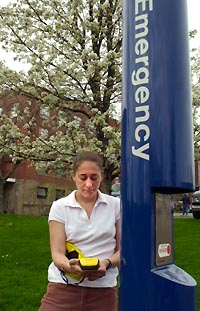
A blue emergency phone:
With great trepidation, but in the greater interests of education, I have embedded a video of the offensive skit below. WARNING!! SEXUALLY EXPLICIT LANGUAGE AND OFFENSIVE COMMENTARY!
What happens when you piss off the intelligent, creative, and tech savvy? These protests are appealing to me as they draw on two of my favorite dynamics: 1) musical parody/social commentary, and 2) critical examination of the legislative law-making process which is too often passed off in civics classes as benevolent public policy making for the common good. Pick your favorite version!
WARNING! This one uses the F-word, as in "Don't f**k with the internet!" But it is really very good and I think speaks to undergraduate students in their own idiom.
WARNING! This one also includes the F-word. For better or worse, it is part of the lexicon of protest.
. . . and too many more to include here. Go to youtube and search "SOPA song."